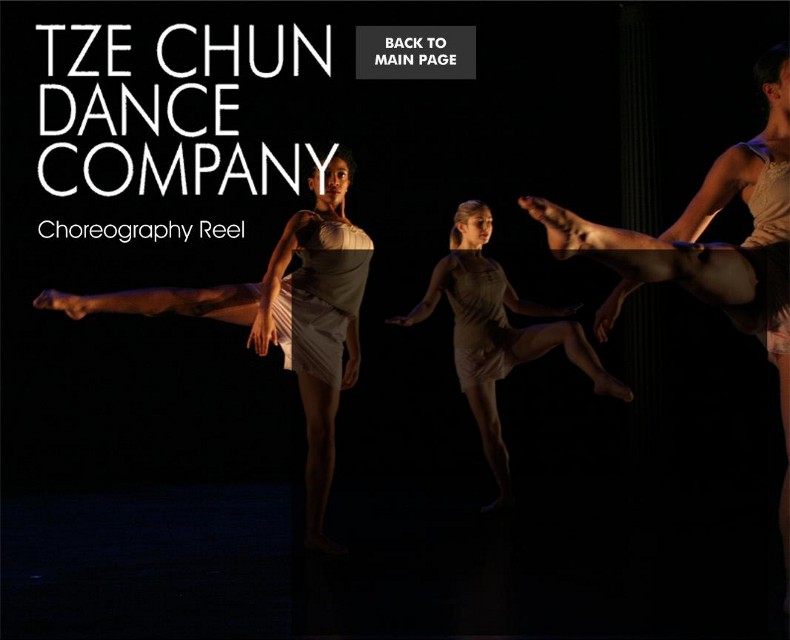
TAKEN (2011)
Premiere: Tribeca Performing Arts Center (TPAC), NYC
Full Length: 55 minutes/ 4 dancers
Original Score by Richard Vagnino
Created in residency at TPAC 2010-2011
TAKEN examines the concepts of transport and transition. What lessons do we learn from our experiences, that we then carry through life?
A devised project, TAKEN draws imagery and details from the dancers' own experiences. Using the image of a suitcase (and its inherent associations) as a point of departure, TAKEN investigates the relentless human desire to hold, carry, and possess.
Excerpts from: Up and Up (2010)
World Premiere: BeijingDance / LDTX Theater
Beijing, China, July 2010
Full Length: 23 minutes/ 4 dancers
Created by Tze Chun and Daniel Iglesia
Up and Up is a new performance piece that explores art perception and classification between popular and highbrow. It combines dancers with live video capture and playback to sample and multiply the dancer's image. This creates a uniquely fused interaction between the previously distinct media of dance, video, and sound.
Trailer for Parlour Games (2010)
Various historic locations, Spring 2010
Full Length: 40 minutes/ 8 dancers
A free Brooklyn dance series, Parlour Games addresses our current culture of entertainment by investigating Victorian parlor games of the late 19th century. These games were often unruly and risqué - created as cultural outlets for aggression, sexual tension, and other departures from civilized etiquette.
Sunderland (2009)
The 92nd Street Y, January 2010
Full Length: 7 minutes/ 7 dancers
Argentine Tango sets the mood in the Tze Chun Dance Company’s "Sunderland".
Born in the barrios of Buenos Aires in the late 19th century, Tango quickly became a
common language for the diverse working class. For over a century, gender, race and class
politics have been negotiated through this dance form’s intricate and powerful steps.
Inspired by Tango’s rich history, "Sunderland" uses modern dance to examine the Argentine
spirit of speaking through movement.
Excerpts from: Go-ban (2007)
"TC/DC in Concert"
CSV Center, NYC June 2008
Full Length: 12 minutes / 9 dancers
Original Score by Daniel Iglesia
*This work premiered at WaxWorks in 2007, and has been presented at Riverside Theatre, Minor Lathem Playhouse, Dance New Amsterdam (www.dnadance.org) and Dance Theater Workshop (www.dtw.org)
Go is a traditional board game from China and considered the oldest game still played in its original form. A game of strategy and no chance, Go reflects Asian philosophies on war, art, and life itself. The Goban is the wooden board upon which the game is played, and the stage upon which the drama of Go unfolds.
Influenced by Go game theory, and the visual and visceral aspects of the game, Tze Chun transforms the stage into an intellectual landscape in her latest work Go-ban. Based upon real-life game patterns and stone formations, Go-ban follows the games specific form of movement and response, action and reaction.
Set to an original score by Composer Daniel Iglesia, who utilizes the recorded sounds of Go stones as the primary source for his electronic elaborations, Go-ban creates a safe-space in which larger issues of power and war are played as innocently as a game.
For the Record (2008)
"2008 Dancenow NYC Festival"
Dance Theater Workshop, NYC September 2008
7 minutes 40 seconds / 5 dancers
Music by Patsy Cline, 蓓蕾, and 儋小屏
As director Akira Kurosawa said, "To create is to remember. Memory is the basis of everything." For the Record examines the concept of memory and nostalgia through a playful lens of retro Singapore aesthetics and 1960's radio. Set to music by Patsy Cline and Chinese covers of Beatles songs, this work explores how memories and expectations (like radio music) are distorted through time and distance.
A first generation Asian-American, choreographer Tze Chun presents the immigrant experience from a child's point of view: looking to belong in the narrative of all-American love songs, and at the same time feeling pride and comfort in the voice of Chinese lounge singers such as Grace Chang. The work asks, "How do we experience nostalgia for things before our time, for times we never live through?"
Excerpts from: Out and About (2008)
"TC/DC in Concert"
CSV Center, NYC June 2008
Full length: 28 minutes / 5 dancers
Score by Daniel Iglesia
In this experimental work, choreographer Tze Chun examines the new context for culture and politics being created by today's younger generation. How do today's means of communication and activism compare to the tools used by radical movements in the past? Being "out" acting for a cause, and writing "about" action are two very different things. Out and About explores exhibitionism, rebellion, and the numbness of being immersed in a virtual life.
Out and About is an experiment in the limits of inhibition and examines the comfort with which people today document previously private aspects of their lives.
The dancers consume actual alcohol over the course of the 26 minutes work, and as they toy with the real effects of alcohol and its consequences both physical and social, audience members are implicated as by-standers to the self-destruction they are witnessing.